
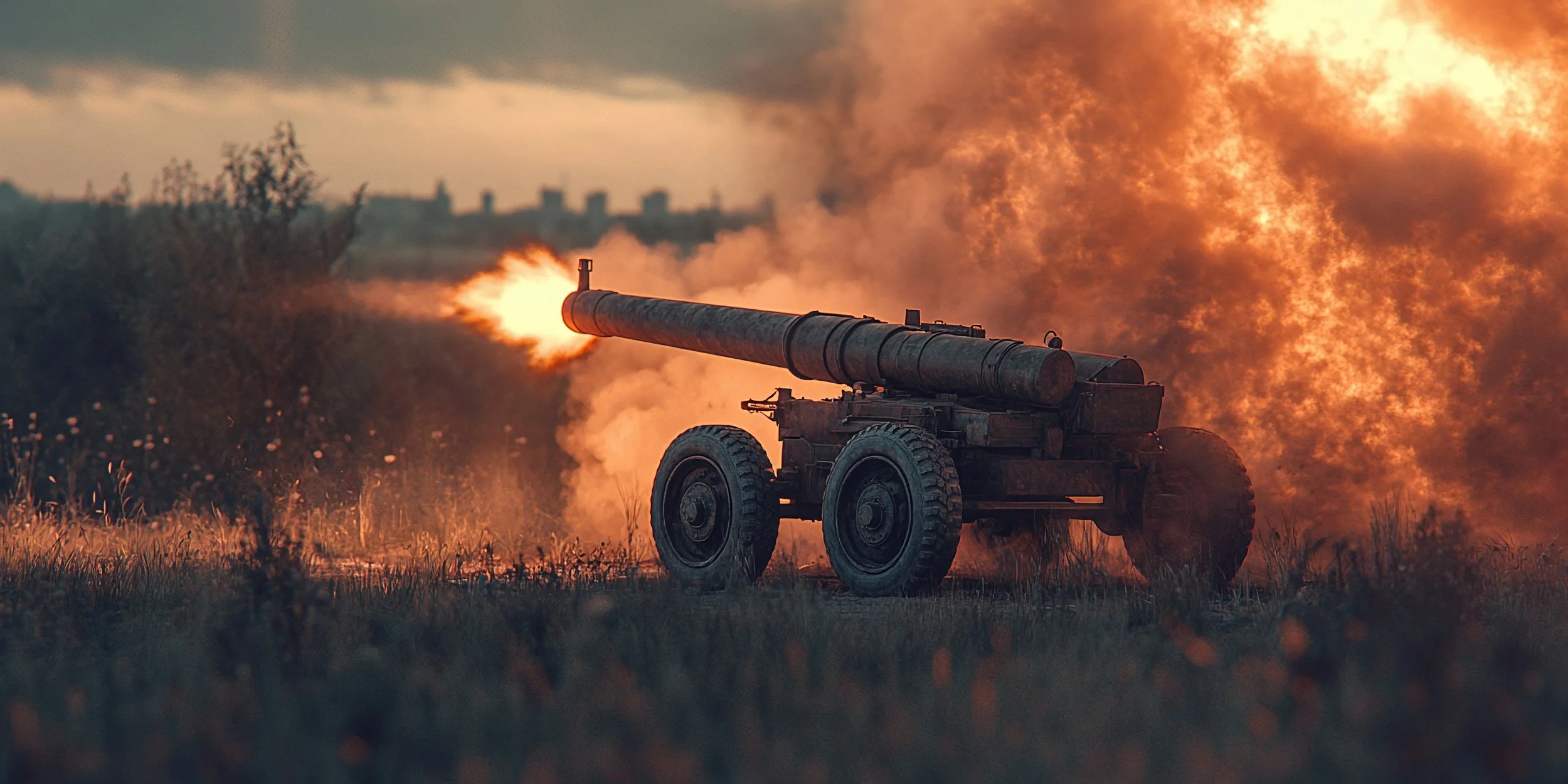
THE CONCORD INDEPENDENT BATTERY
Battery formed for inspection, April 19, 1906
A section composed of World War I veterans
THE tradition of artillery in Concord extends possibly from September 1774 but certainly from January 5, 1775. It started with the Colonial Militia of the town under the Committee of Safety, soon merged into the Revolutionary Army, was revived by the Commonwealth of Massachusetts, continued under the Concord Artillery and the succeeding infantry company of the militia, and finally reverted to the town to be fostered eventually by the Concord Independent Battery
Association. In 1774, during the summer, the Massachusetts Committee of Safety was scheming to obtain guns for the artillery of the Provincial Militia, and General Gage had done his best to forestall them. In his book The Minutemen, Galvin writes that Gage felt his primary to Ity was keep the provincials, which his estimates placed at 30,000, from organizing into an army. The specific point his attention fastened on was their capacity to employ artillery, and to prevent this, his aim became the seizure or destruction of rebel cannon. One night in September 1774, Gage sent troops to seize a harbor defense battery in Charlestown but the provincials, suspecting the move, spent the early hours of the night transferring the guns toward Salem and Concord on log-hauling wagons hastily gathered for the purpose, so the British on arrival at the location found nothing left of the battery. A few weeks later, four brass cannon especially made for field use were spirited away from the British Gun House on Boston Common. When, in February, Gage heard of a cache of guns at Salem he secretly despatched over 20o men by ship to Marblehead. The troops, marching to the forge in Salem where the guns were located, were held up by a drawbridge, and before they could cross, the dispersal of the guns to the surrounding country had been completed. The Committee of Safety, too, had been busy during this time. At a meeting November 16, 1774, "It was Voted: To procure seven large cannon and get them out of Boston to some place in the country." An order of January 5, 1775 provided for two brass cannon, and in February certain other pieces that had belonged to the provincial militia were ordered sent to Concord. These were very likely the cannon referred to in the Concord Town Meeting of January 27, 1775, "ARTICLE: To see if the Town will recommend that a sufficient number of the company in the town call'd the alarm company take the care of the cannon in this town when mounted, and learn the exercise thereof, and that a master of gunnery be provided by the town to teach such exercise. Requested by Capt. Charles Miles and others."
CONCORD INDEPENDENT BATTERY
Presumably favourable action is indicated by the following record of the Town Treasurer:
RECEIPT
To
Mr. Asa Brooks, one of the Constables of the Town of Concord, for mounting two cannon. March 1775. Paid to Mr.. for the carriages 2-8-0
Made at Watertown
Also paid Amos Wood for bringing said carriages from Watertown 0-3-2 May 16, 1775 ... Paid Mr. Sam'l Jones for Iron Work of the wheels & Carriages 10-19-3... Paid Mr. Abijah Bond for two sets of boxes for wheels . .. o-6-o. June 10, 1775 ... Paid Lt. Francis Wheeler for making one set of wheels and axeltrees etc. 3-2-8. Paid Wm. Parkman for making a set of wheels etc. On April 17 the Committee of Safety directed Colonel James Barrett to mount two cannon and raise an artillery ery comppany. But Colonel Barrett was too busy to do anything about this for he had his hands full hiding guns and stores from the British who marched out the next night under Colonel Smith whose orders from Gage were to march to Concord... and destroy all artillery and especially "If you meet with any brass artillery you will order their muzzles beat in as to render them useless". The British were too late at Concord, for all the previous day and far
into the night, the provincials moved their supplies and arms out of the town. They carted four cannon to Stow and six more to various hideaway places on the outskirts of town, the others they hid in cellars and barns. Some, it was afterward said, were laid in furrows of Colonel Barrett's field and buried. One may assume that the cannon which had been hidden in Concord and the others soon went to the army gathering in Cambridge and to Bunker Hill and eventually to Dorchester Heights, where they helped drive the British from Boston the next year. After the evacuation of Boston by the British, the local artillery organization in Concord lapsed during the remaining years of the Revolution. Afterwards there is some evidence that traditions were maintained by a patriotic and social group. The Boston Newspaper Independent Chronicle and Universal Advertiser in the issue of July 10, 1794 has an item headed Concord, July 4 describing the local ceremony in which the Light Infantry and band music, the Rev. Mr. Ripley, William Jones of the Tavern and "many kindred souls from neighboring towns" took part.
CONCORD INDEPENDENT BATTERY
Returning from the church to the Tavern, TOASTS were with drunk "truly republican hilarity and conviviality". The Artillery Company was present, too, under the command of Capt. Bradley and among the more than a dozen TOASTS were:
"The Birthday of American Liberty!"
(3 cheers and 15 guns)
"WASHINGTON!"
-15 guns - The Washington March)
"The departed Hancock — May his grave like his fame
be ever in bloom!"
(Applause and 13 guns)
and so on through Samuel Adams! Moses Gill! United America! General Kosciusko! Our unfortunate brothers in Algiers! and more. Within ten years enthusiasm grew for an authorized military group and the state legislature authorized a company of artillery by the following action:
COMMONWEALTH OF MASSACHUSETTS
In Senate, February 24,1804
Whereas, It is the duty of an enlightened Legislature to excite and en- courage an ardent love of country, a generous public spirit, and an elevated degree of military discipline among the citizens, all which form the cheerful and most efficient defense of the precious blessings of society; and whereas, Major John Buttrick and Captain Isaac Davis, with a party of the armed yeomanry, did on the birthday of our Revolution attack and defeat a superior number of the invaders of our country, who were most advantageously posted at the North Bridge in Concord: In order, therefore, to commemorate and render honor to the action which led to the victory of the day, and to perpetuate the names of the gallant Buttrick and Davis (the latter of whom fell in the action), the leaders of that little band, and also to animate in future the ardor and bravery of the defenders of our country:
Be it Resolved, That the prayer of the petition of Charles Hammond and others be granted,
and the Governor and council be, and they hereby are, authorized to raise by voluntary enlistment a company of Artillery within the third Regiment, first Brigade, third Division, provided none of the standing companies in said Regiment shall be reduced to a less number than sixty-four privates, and that no more shall be enlisted from the troop of cavalry or company of light infantry which are attached to said Regiment, and the company when raised shall be attached to the Battalion of Artillery in said Brigade.
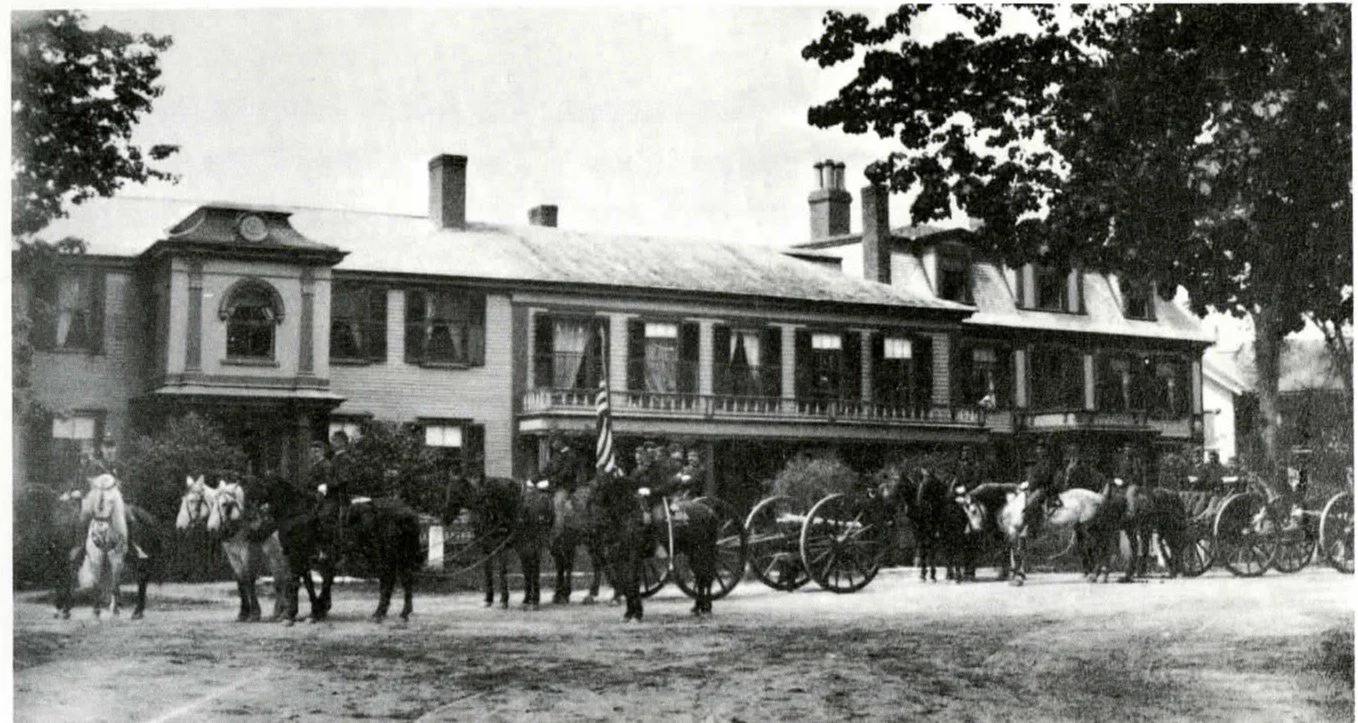
The Battery for breakfast at the Colonial Inn, early twentieth century
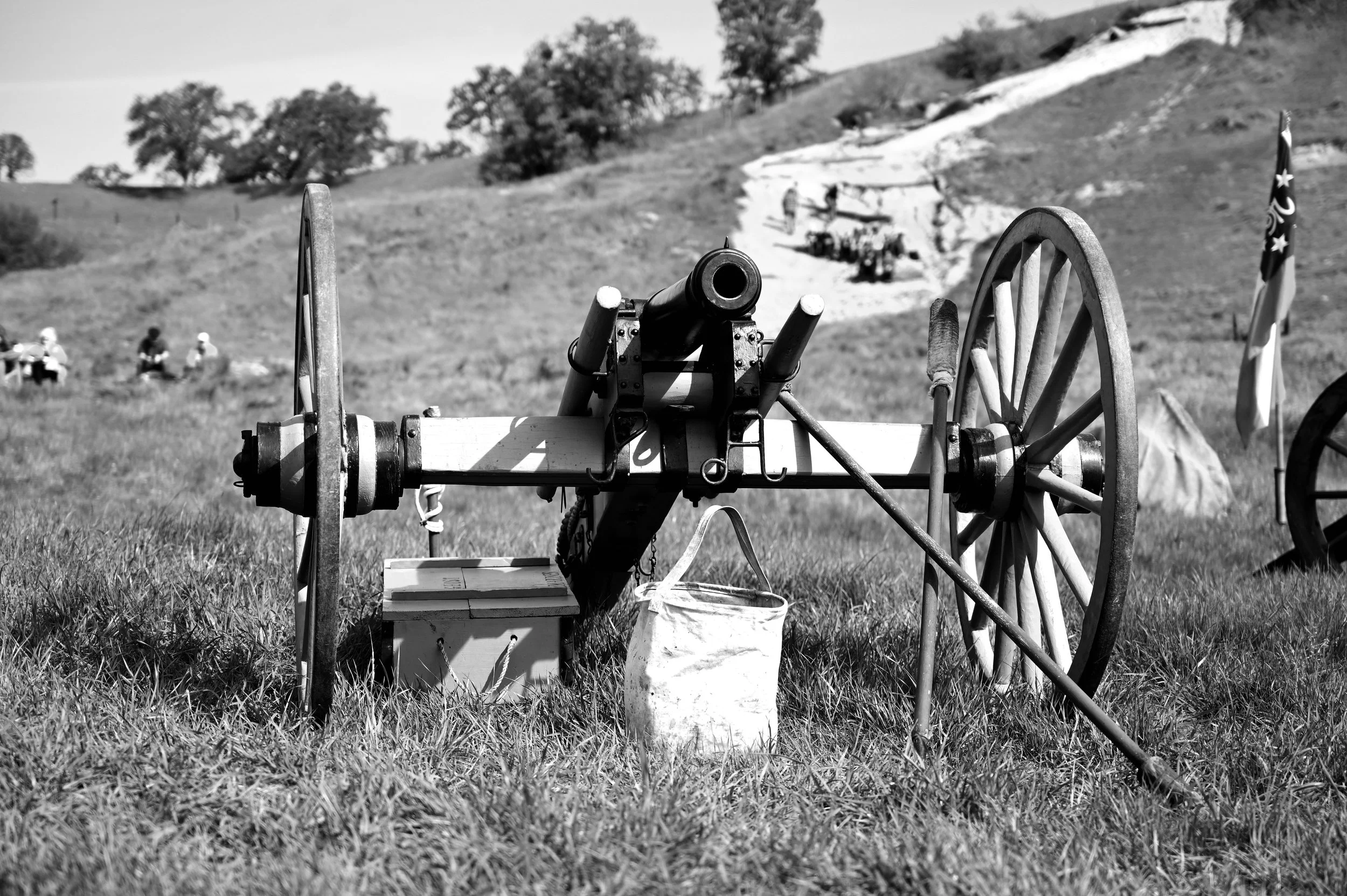
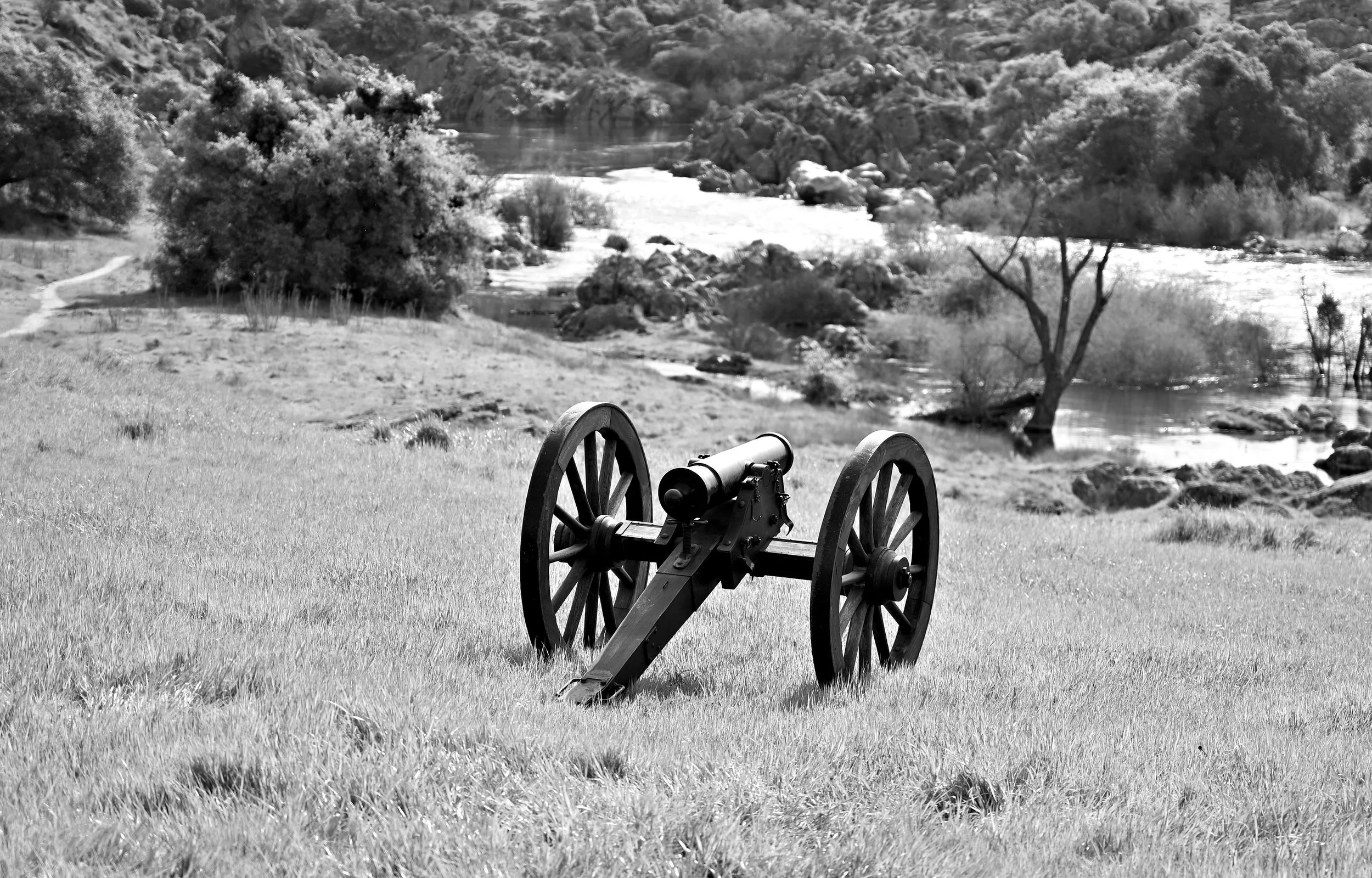
That two brass field pieces of artillery, with proper apparatus, be attached to said company, and that there be engraved on said pieces of artillery, Concord Bridge, 19th of April, 1775, and also a short detail of the action, with the names of Buttrick and Davis, and that the Quarter Master General be charged with the execution thereof. Sent down for concurrence. House of Representatives. Read and concurred February 24, 1804. Approved. David Cobb, President H. G. Otis, Speaker CALEB STRONG. The inscription engraved on the cannon follows: "The Legislature of Massachusetts consecrate the names of Major John Buttrick and Captain Isaac Davis, whose valor and example excited their fellow-citizens to a successful resistance of a superior successrur resistance or a snd number of British troops at Concord Bridge, the 19th of April, 1775, which was the beginning of a contest in arms that ended in American independence" The two cannon received had been cast in 1780 by W. Kinman and are marked with the figure 4 and the letters VE I C which have been interpreted to mean 4th Reg't, Venerable East Indian Company. The new company was raised in Concord by voluntary enlistment. Its first activity was a parade on the common July 4, 1804. Elsewhere there was a general trend at this time to form elite militia batteries, notably in Boston, Newport, New York, Philadelphia, and Richmond.
CONCORD INDEPENDENT BATTERY
They were social as well as military. Great enthusiasm was aroused by the Concord Artillery with Thomas Heald listed as its first Captain. The uniform was an elaborate blue coat faced with red, white vest, blue pantaloons and black cockade tipped with red. Mounted on their caissons of Prussian Blue, possibly with red wheels, they must have made a colorful sight. The cannon were kept in the Gun House near the milldam and used regularly for training. Drills were well attended, careful records kept, and fines imposed for absence. It is probable that the equipment was similar to that of the regular field artillery. Six pounders taking a charge of 114 lb. of powder. Point blank the range was about 300 yards but with an elevation of 5° the range was nearly 1500 yards. This was for solid shot. The range for cannister was less. It was ten years before the company was called upon for active military duty. When Boston was threatened by British warships, during the War of 1812, it was sent under Captain Reuben Brown, Jr., to South Boston with the Light Infantry Company to guard the harbor entrance for a few weeks. During the following years the company drilled and
trained, had their social meetings at the Middlesex Hotel, and paraded regularly on April 19th. But in 1840 the old form of compulsory militia was given up and an entirely voluntary active militia was organized in the state. All existing
organizations were disbanded and a new system adopted. The Concord Artillery under Lt. Ward D. Safford found itself Company A in the First Regiment of Artillery of the Third Brigade, Second Division, with Charlestown, Watertown, and Lexington. Many other artillery companies were changed to infantry. The Adjutant-General began a series of inspections and the Concord gun house was found "so poorly built that the company has been obliged to put iron rods through the building to hold it to-gether". At this time the pay was $6 per year and each man had to furnish his own uniform. The company kept up active training, however, and to such an extent that in 1846 the cannon had become tome sowom so worn
by firing as to be unsafe, and were exchanged for a new pair of field pieces and the old cannon returned to the state arsenal. Their final disposition was determined by the following legislation in 1859: RESOLVED: that the adjutant-general be authorized and instructed to remove, forthwith, from the state arsenal, at Cambridge, to the doric hall of the state house, two pieces of ordnance, formerly in the possession of the Concord Artillery,......said guns to be
properly mounted and located in some appropriate place, under the direction of the commissioners on the state house, and kept where they may at all times be convenient to public inspection.
The inscription on the old guns was engraved on the new ones by Daniel Adams, a private in the company. The reorganization of the militia continued and although Company A of Concord was awarded First Artillery Honors in 1849, it was changed to infantry as were many of the other Artillery companies in the state. In 1855 it was assigned to the 5th Infantry Regiment when the terms artillery and Light Infantry were abolished. The cannon remained in the possession of the town, however, and a Town Meeting July 22, 1854 under Article 4, "Voted that the selectmen be authorized to give a bond for the safekeeping of the Field Pieces of the Concord Artillery Com- pany". Two years later at the April 7 meeting it was "Voted, to ap- propriate the sum of one hundred dollars for the purpose of fixing up the Armory of the Artillery & care for the field pieces, to be expended under the direction of the officers of said company and that the sum be taken from the Treasury out of monies not otherwise appropriated". It was also voted that the free use of the Town Hall be granted to the Artillery, for a dance on the evening of the 18th of April. With the general increase of military activity in preparation for the annual musters preceding the Civil War, the old cannon had little attention. Even the Adjutant General forgot that Concord had them. They were remembered though near the end of the war as the town records show "Expense of firing salutes on the taking of Richmond, Lee's surrender, July 4th, and minute guns during the time of the funeral ceremony for President Lincoln". Despite the fact that many war veterans manned the guns, the first of several accidents occurred on July 4th. The rammer on one piece, Charles H. Dean, had his arm blown off by a premature explosion. Ironically he had been on the USS Fearnot with Farragut at New Orleans in April 1862 and gone through the battle with no injury. This was a fairly common accident. In fact, the first recorded accident with artillery in America was when a gunner with the Coronado Expedition in 1540 lost his hand when a cannon went off before he had completely withdrawn the rammer. In the general checkup of ordnance after the war the AdjutantGeneral asked the town to account for the cannon; and then, when the old company disbanded, lacking members, he recalled the guns, a great
protest arose in the town. Considerable money was raised, new members recruited, political influence applied, and the order was rescinded. Many 'honorary' dues-paying members joined and the organization became almost as social as military. The town bought the Agricultural Society lot between the cemeteries on Bedford Street and fixed up the building with "a large drill room in the center and with ample accommodation for the cannon in the rear end". The Adjutant-General continued to note the town's possession of the cannon and on March 2, 1876 requested "a bond for the property loaned to the town at the request of Gov. Claflin May 11, 1869". And in April the town gave bond for
2 Bronze Guns 6 Pdr.
2 Gun Carriages with Limbers
4 Prolongues
8 Hand Spikes
4 Worms with Staves
4 Sponges & Rammers
4 Gunners' Haversacks
2 Tube Pouches & Belts
2 Priming Wires
2 Tampions with straps
4 Sponge Buckets
2 Gun Covers
2 Artillery Harnesses (2 Harnesses)
2 Lanyards
The guns continued to be fired in salutes each April 19 and we reespecially active in 1875 when President Grant came to the Centennial. Each year the guns were fired again on July 4 and the battery mounted took part in Memorial Day Parades. Another accident occurred July 4, 1871 when Ephraim W. Bull, Jr. lost a hand. In Bedford August 27, 1879 the Battery took part in that town's 150th Celebration and the next year in November, the night before the election of President Garfield in 1880, they paraded in Marlborough returning in time to fire a salute of 100 guns to celebrate his election in Concord. One gun was loaned to Acton for July 4 in 1881 and another accident occurred. An Acton man
had his hand shot away through a failure, according to a Concord reporter, to receive skilled artillerists from here to manage the gun. The local paper in 1883 reported of the Memorial Day Parade, "Concord people ought to feel proud of the appearance of the battery, well mounted, well drilled, and the firing gone through without accident". The people of the town thought they owned the guns but again in 1884 the Adjutant-General asked for their return to the state. The
powers that be then got busy and introduced a petition by the Concord Selectmen "that... said field pieces be conferred by the legislature upon the town of Concord for the use of its military company under the direction of the Commander-in-Chief in preparation of their historic renown and services." This was granted in 1887 as follows: RESOLVED, That, for reasons set forth in the petition of the Selectmen of the town of Concord, the Governor is hereby authorized to confer upon the town of Concord the two brass field pieces heretofore used by the Concord Artillery Company, and bearing the following in
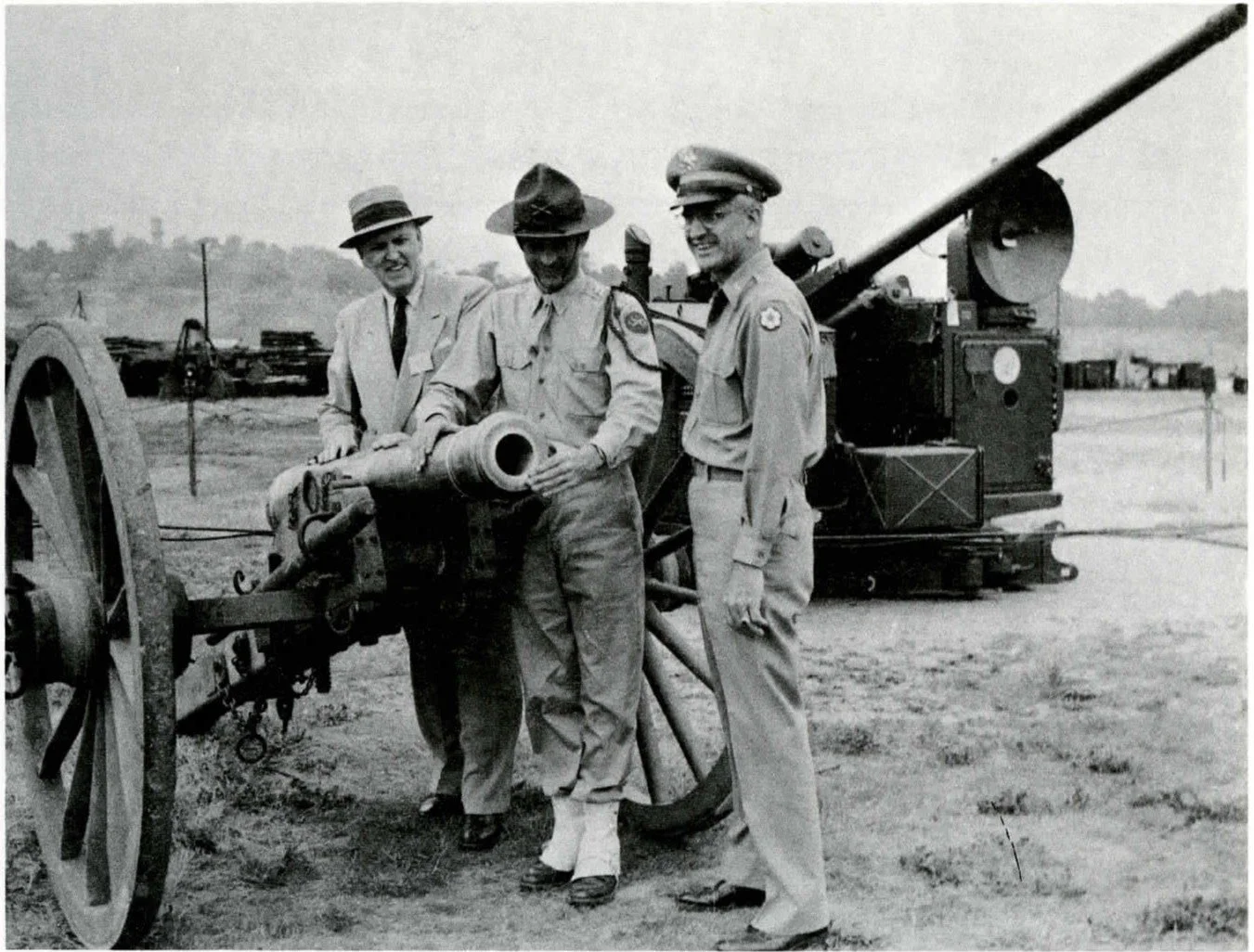
Inspection of relined guns at Watertown Arsenal, 1956
would not be advisable". The observances of the holidays in 1904 and 1905 required the presence of the battery, the first year the hundredth anniversary of the Concord Artillery, and the second, the 130th of the Concord Fight.
The name for the battery varied through the years. Usually in the order of march it was called the Concord Battery, but sometimes the Old Concord Battery or even the Concord Light Artillery. As late as 1914 in the Town Report the Selectmen refer to it as the Concord Battery. In fact, it is another twenty years before the Town Report mentions the Concord Independent Battery and then only in a report of the Celebrations Committee of the American Legion, which was in charge that year. However, in a newspaper report of the Order of March for 1904, it is the "Concord Independent Battery under command of Captain Samuel H. Tuttle"; and then in 1905, "Theodore L. Smith, commanding." One of the few social affairs sponsored by the battery took place in 1906 under Commander Smith. Handsome engraved invitations went out to the townspeople asking them to three dances January 27th, February 21st and April 18th. These may have been given to raise money, for that year members were supposed to provide themselves with new khaki uniforms with red facings, campaign hats, leather belts and gauntlets. 16 Also red saddle blankets were purchased. For several years following, members bought their own uniforms when joining. In 1909, the battery turned out on April 19th under Sergeant Robert E. Goodwin, later Colonel Goodwin, who commanded the 101st Field Artillery, Yankee Division in World War I. His energy and experience of several years in the National Guard with Battery A in Boston, plus his recruitment of several other young men of the town to Battery A who then helped him turn out the Concord Battery, stimulated general interest. Eventually, more than a dozen experienced drivers and cannoneers were regular members. At this time too the breakfasts after the sunrise salutes were inaugurated, and the mid-winter dinners in Boston, rarely at a hotel or restaurant where it had been held the previous year. It was possible also to equip the outfit with the current National Guard khaki uniform, britches, leggins and blouse with felt campaign hat and red cord, which added to the improved military aspect of the holiday turnout. Only the horses were a little rustic. These were obtained locally from sympathetic farmers or contractors. Their drivers accompanied them with enthusiasm and were made full-fledged members of the gang. Horse hire and other expenses were not excessive. For 1912 the record shows: American Powder Mills - Supplies Meals for Battery Horse hire $10.56 16.50 49.00 World war was fast approaching, preceded by the affair on the Mexican border. Young men were getting involved in serious military preparation and attention to the battery lapsed for some time. This was not the reason stated by the Selectmen in their 1917 report, however. For April 19, 1916 they say "No salute was fired this year, and, as our brass cannon are of the muzzle-loading variety, we are of the opinion that their use for saluting purposes should be discontinued". Within a short time many members of the battery were an ocean away using more modern guns and not for saluting purposes. It seems likely that their connection with the battery influenced the ones who had a choice, to select the artillery for their service in the army during the war. Certainly Concord was well represented in the Artillery of the American Expeditionary Force in France in 1918. Consequently in 1919 it was possible to select from veterans of the war, Majors, Captains, Lieutenants, and non-commissioned officers to provide the personnel for the annual turnout. No discrimination was practiced, however, and marines, sailors, aviators, and troopers of cavalry
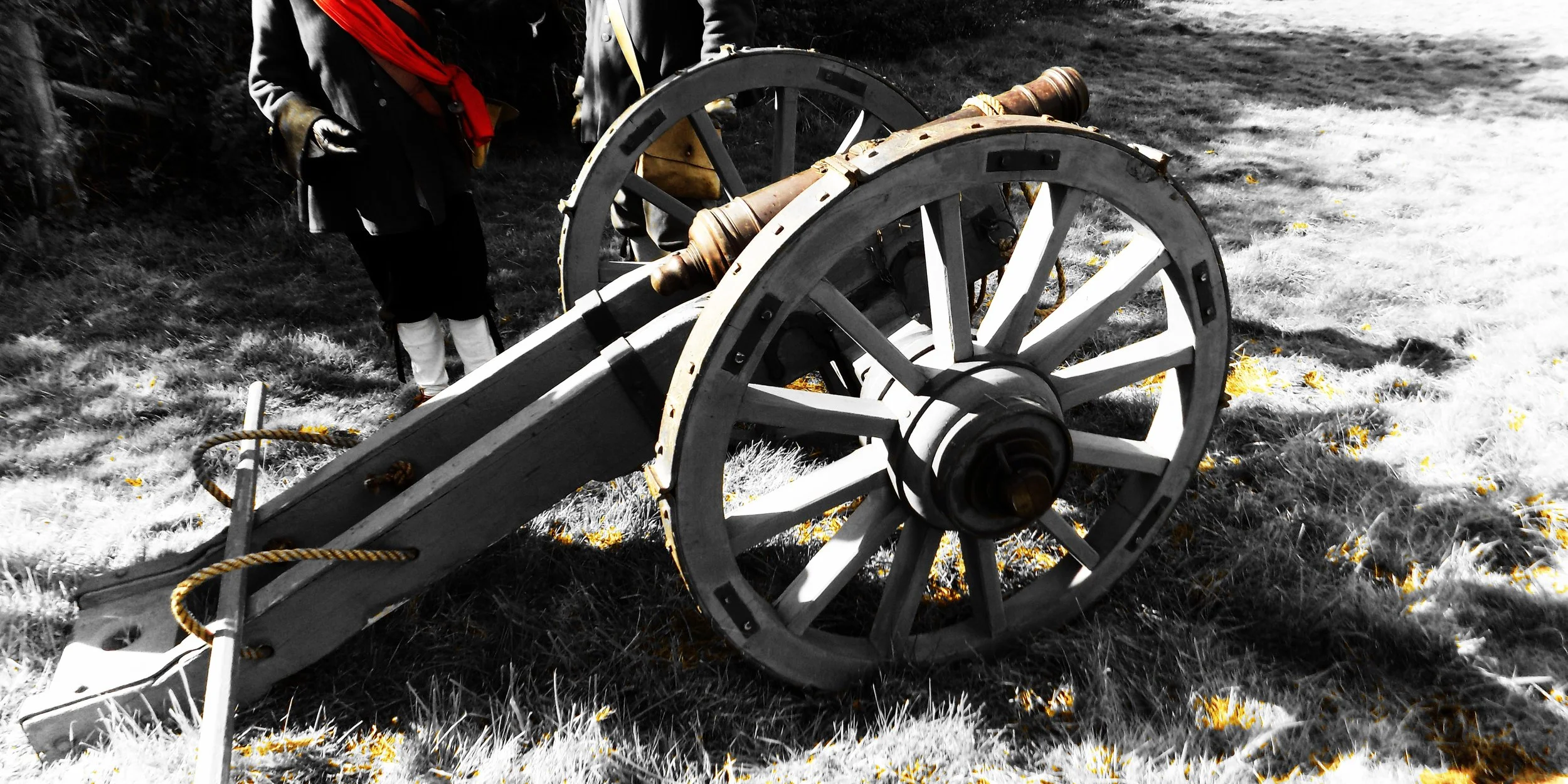
found their way into artillery uniforms on April 19th. Acceptance to the battery organization depended on the spirit of the man, and if he had the right kind he would soon be initiated into the mysteries of the Concord Cannon. The greatest mystery was the military organization of the battery (if any). The town received the cannon as a gift from the Commonwealth in 1887. Prior to that they were on loan, and the Selectmen controlled and authorized their use as they continue to do. But there is no record over the years of any organization, or appointment by the Lou Selectmen of personnel to activate the annual turnout. Only in the 1940's are there reports by the Commander printed in the town reports. Presumably there was verbal authorization many times reluctantly given, due to the objections of an always present conservative group who were disturbed by the sunrise salute. On the other hand, there was an enthusiastic number who considered that celebration without the guns was no celebration at all. While, perhaps, no organization was desirable, possible or even necessary, an association finally evolved which undertook to sponsor the battery and provide financial and popular support. In 1947, A. Page Browne, a former commander, gathered together a representative committee which prepared a form of association which was proposed to the Patriots Day Breakfast the following year. The suggestion was adopted by all present and the Concord Independent Battery Association was thus formed with three classes of members, a president, secretary-treasurer and a commander. These with three active members and the Captain of the local National Guard organization made up an executive committee. Small dues were assessed all members. This still entirely voluntary group provides some financial support and helps build up experienced manpower. Such support is needed for crises of one sort or another that occur. One such was the difficulty of getting horses for a few years after 1947. Jeeps were used but were so incongruous that special efforts were made to find horses for at least the important parades. The Association also provided, in 1956, for the restoration of the cannon to firing condition at the Watertown Arsenal, after it was suspected that the tubes were sufficiently worn and pitted to make firing hazardous. The support of the Association was again valuable in 1960, when the Town Meeting seriously considered the necessity of demolishing the Veterans Building where the cannon had been housed in the basement for many years. An enterprising group sug suggested that funds be raised by popula subscription to provide the town with an appropriate gun house for its 18th century cannon. A member of the Battery, an architect, Andrew Hepburn, prepared plans modeled after an old gun house in
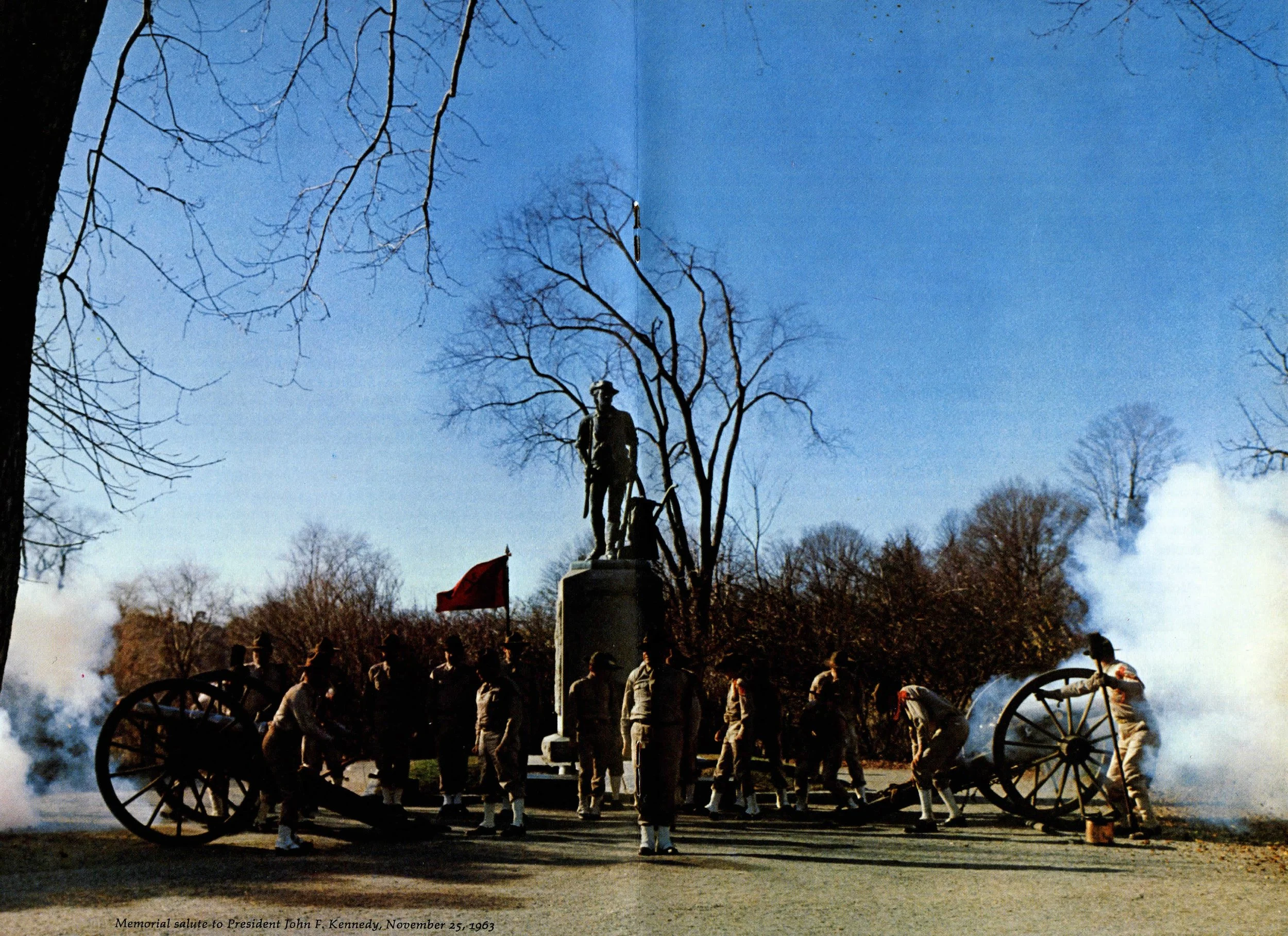
18 CONCORD INDEPENDENT BATTERY Marblehead, built in 1800. It was proposed to raise $16,500 for the building to be placed on land owned by the town on Lexington Street. On February 29, 1960 the Town Meeting voted to accept the fund raised and permit the erection of the building on the land selected. Work commenced and with the funds collected and labor and materials contributed by several local contractors and builders, the handsome home for the guns was completed in time to be dedicated April 19, 1961. The battery fired a salute of 21 guns at the solemn ceremony at the North Bridge, November 25, 1963, the day after President Kennedy was assassinated. Nearing its 20oth year in Concord the tradition of artillery in the town is kept alive. The thrill of the participation of the battery in the ceremonies was expressed by former Commander Theodore Smith, in 1048, when he wrote, "Ever since I can remember the parading and firing of the battery, the clatter of hoofs, the clanking of chains, the rumble of wheels, the fluttering of the guidon, the bugle calls, the ever faithful Lanyardman, the courageous Rammer, and the scampering Powdermonkey, have been for me the most important and thrilling part of Concord celebrations." And there is no doubt that the holiday visitor to Concord, despite his exposure to all the historical sites, remembers most vividly the parade and salutes of the Concord Independent Battery.
***
Active Membership as of April 19, 1972
Anderson, William W.
52 Hubbard Street Concord, Ma.
Barker, Bruce B.
88 Monument Street
Concord, Ma.
Browne, A. Page browne, A. rage
177 Barnes Hill Road 177 barnes ill Ro Concord, Ma.
Coolidge, Frank P., Jr.
91 Sudbury Road
Concord, Ma.
Cull, Raymond V. 2nd Lieut.
51 Assabet Ave.
Concord, Mа.
Daniels, Edward
1 Old Stone Road
Darien, Conn.
DeMao, Samuel J. DeMao, Samuel
62 Birch Drive
Concord, Ma.
Finigan, James E.
75 Walnut Street
Concord, Ma.
Horne, Edward C.
65 Nashoba Road
Concord, Ma.
Kenny, Lawrence J. Capt.
88 Virginia Road
Concord, Ma.
Kenny, James W.
88 Virginia Road
Concord, Ma.
Lawrence, Raymond B.
1521 Monument Street
Concora, Concord, Ma. ма.
Macone, Alessandro
10 Hitching Post Road
Chelmsford, Ma.
Macone, Ralph A.
478 Lowell Road
Concord, Ma.
*Powder Monkey
MacPherson, C. David
46 Nagog Hill Road Acton, Ma.
MacPherson, Ian*
46 Nagog Hill Road
Acton, Mа.
Morris, Freelon
364 Thoreau Street Concord, Ma.
Pagano, Anthony J.
165 Central Street
Concord, Mа.
Pagano, Dominic F. Rad 333 Bedford Street
Concord, Ma.
Prentiss, Donald R. Donald R.
21 Woodland Road 21 oodland
Concora, Concord, ма. Ma.
Ryan, Richard S.
574 Bedford Street
Concord, Ma.
Ryan, William J.
120 Evergreen Lane
Carlisle, Ma.
Smith, Lowell S.
110 119 Sudbury Road
Concord, Ma.
Smith, Stephen L. Si, L.
383 Lowell Road 305 Lowell Noad
Concord, Concord, Ma. via.
Wheeler, Harvey 1st Lieut.
292 Musketaquid Road Concord, Ma.
Whitney, John R. Jr.
77 Coolidge Road
Concord, Mа.
Yauga, Michael S.*
131 Assabet Ave.
Concord, Ma.